Refrigerator troubleshooting
GE Refrigerator Problems: Cooling, Ice Maker & Display Codes
What common GE refrigerator symptoms and display codes mean, what you can safely check, and when to schedule a diagnosis.
Quick Answer
Start with the exact display, not a list of parts. On some GE refrigerators, tC and tF tell you that a cooling feature is on. A flashing FF can warn of rising freezer temperature, while CI points to an ice maker check. GE, GE Profile and Café controls can behave differently, so match the code to the model.
What To Check Before Replacing a Part
Write down the complete model number, photograph the display and measure both compartments with appliance thermometers. Note where frost, water or noise first appears. The same symptom can come from more than one part.
GE Refrigerator Symptom Checker
Start with the symptom you can observe.
| Symptom | Safe first check | When to get help |
|---|---|---|
| Display looks normal but both sections are warming | Measure both compartments and confirm cooling is on. | Check fans, controls and cooling system if both readings keep climbing. |
| Fresh-food side is warm and freezer still works | Clear visible vents and record where frost forms. | Check the model’s airflow and defrost components. |
| Ice maker is empty but the dispenser still runs | Check the switch, freezer temperature, ice bin and water flow. | Trace the fill valve, tube or ice maker if the bin stays empty. |
| Ice is in the bin but does not come out | Check the control lock, bin seating and loose clumped ice. | Check the auger drive and chute mechanism if ice stays in the bin. |
| Drinking water trickles or stops | Check the water shutoff and model-approved filter. | Test flow and trace the restriction if flow remains weak. |
| Frost and fan noise keep coming back | Record when the sound occurs and whether frost returns. | Inspect the fan and defrost assembly when noise and warming occur together. |
| Water on the floor near the freezer | Note the timing of the leak and photograph the first wet spot. | Trace the supply, ice maker or defrost path as appropriate. |
What Varies by GE Model
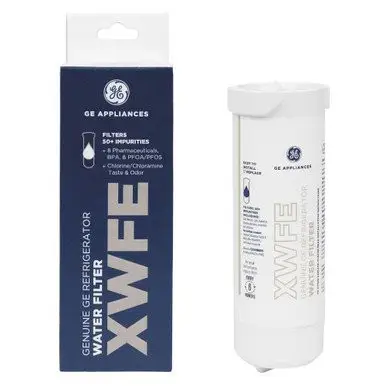
The GE parts collage shows the GSS25GMPGCES configuration. The XWFE filter example below is documented for GSS25GMPES. GE, GE Profile and Café controls vary. On GE models that support them, tC and tF indicate active cooling modes, while FF is a temperature warning.
Technician Tip
Photograph the product label and include the suffix. A part number from a similar-looking refrigerator can still be wrong for your model.
7 Common GE Refrigerator Problems
1Display looks normal but both sections are warming
A display may show a setpoint rather than a measured cabinet temperature. Check an appliance thermometer in each section and make sure cooling is on. If both sections continue warming, have the controls, fans and cooling system diagnosed.
Safe to check yourself
Measure both compartments and confirm cooling is on.
Requires professional diagnosis
Check fans, controls and cooling system if both readings keep climbing.
2Fresh-food side is warm and freezer still works
Check for blocked vents and frost inside the freezer. On some units, airflow from the freezer feeds the refrigerator; other models use a different design. Give the technician the model before buying a damper or motor.
Safe to check yourself
Clear visible vents and record where frost forms.
Requires professional diagnosis
Check the model’s airflow and defrost components.
3Ice maker is empty but the dispenser still runs
Check whether the ice maker is switched on, the freezer is actually cold and the bin is fitted. A working water dispenser does not prove the ice maker’s fill path is clear. Mention when CI appears and whether a filter was changed recently.
Safe to check yourself
Check the switch, freezer temperature, ice bin and water flow.
Requires professional diagnosis
Trace the fill valve, tube or ice maker if the bin stays empty.
4Ice is in the bin but does not come out
Separate an ice production fault from a dispensing fault. Look for loose clumped cubes in the removable bin and verify the controls are unlocked. If the dispenser makes noise but does not move ice, keep hands clear of the chute and have the drive checked.
Safe to check yourself
Check the control lock, bin seating and loose clumped ice.
Requires professional diagnosis
Check the auger drive and chute mechanism if ice stays in the bin.
5Drinking water trickles or stops
Confirm the household shutoff is open and the model-approved filter is properly installed. If the ice maker also slowed, note that because the two systems share part of the water supply. If only the dispenser failed, describe whether it happened after the door or filter was serviced.
Safe to check yourself
Check the water shutoff and model-approved filter.
Requires professional diagnosis
Test flow and trace the restriction if flow remains weak.
6Frost and fan noise keep coming back
Record where frost forms and when the noise begins. A short sound after closing a door can be normal; a scraping noise accompanied by returning frost or rising temperatures needs further investigation. Do not pry ice off a panel.
Safe to check yourself
Record when the sound occurs and whether frost returns.
Requires professional diagnosis
Inspect the fan and defrost assembly when noise and warming occur together.
7Water on the floor near the freezer
Look at the timing: after dispensing, after the ice maker fills, or even with the supply turned off. Photograph the first wet area instead of moving the unit and disturbing the evidence. Close a safely accessible supply shutoff if there is an active supply leak.
Safe to check yourself
Note the timing of the leak and photograph the first wet spot.
Requires professional diagnosis
Trace the supply, ice maker or defrost path as appropriate.
GE Refrigerator Repair Cost Factors
| Repair area | What to ask about |
|---|---|
| Airflow and door sealing | Which part is blocked, worn or electrically faulty? |
| Ice and water | Is the restriction in the supply, filter, valve or ice maker? |
| Compressor or sealed system | Does the model warranty cover parts or labor? |
Ask for a written quote after diagnosis, including parts and labor.
GE Refrigerator Error Code Table
| Code | What it means | What to check or report |
|---|---|---|
| tC / tF | TurboCool or TurboFreeze status, where offered. | If both compartments are cooling normally, this display alone does not call for repair. |
| PF | Power interruption. | Check actual temperatures and follow the model’s instructions for acknowledging the display. |
| FF | Freezer temperature is too high on applicable GE electronic controls. | Check for thawing, an obstructed door or a recent outage. Unlike LG FF, this GE message does not specifically identify a fan fault. |
| CI | Ice maker operation needs checking. | Check the ice maker switch, seated bin, water delivery and freezer temperature before assuming the assembly failed. |
| CC | Refrigerator temperature is outside the expected range. | Check the settings and measure the compartment. Continued warming with normal settings needs diagnosis. |
| DE / dE | GE distinguishes demo mode (DE) from a defrost issue (dE) on the controls it documents. | Take a photo and check the model manual. With DE after installation, confirm demo mode. With recurring dE or frost and poor cooling, request service. |
How To Reset a GE Refrigerator Safely
- Photograph the code and note the current temperatures.
- Find the reset or alarm acknowledgment procedure in your exact model manual.
- If the code returns or temperatures continue to rise, arrange diagnosis.
Maintenance Checklist
- Keep visible cabinet air vents clear.
- Check the door gaskets and drawer closure.
- Use the filter specified by the manufacturer and follow its replacement instructions.
- Follow model-specific instructions for accessible condenser cleaning. Leave electrical panels and refrigerant work to a technician.
Is a GE Refrigerator Worth Repairing?
| Factor | What to compare |
|---|---|
| Quote and warranty | Diagnosis, parts, labor and remaining manufacturer coverage |
| Age and condition | Prior repairs, seals, cabinet and other symptoms |
| Replacement | Like-for-like price, fit, delivery and installation |
GE Refrigerator Repair Across Tampa Bay
See GE appliance repair and our Tampa Bay refrigerator repair service. Share your ZIP code and model when booking to check availability.
GE Refrigerator Troubleshooting FAQ
Does GE refrigerator code FF mean the freezer fan failed?
Not by itself. On GE’s documented electronic dispenser controls, FF warns that freezer temperature is rising. Check the actual temperature and door closure, then diagnose the cause if it stays warm.
Should I keep resetting the refrigerator?
Save the exact code first and follow the model instructions. If it returns or the appliance continues warming, check temperatures and arrange diagnosis.
What should I tell the technician?
Send the full model number, the exact display code, both compartment temperatures and when the symptom started. Include any recent outage, filter change or move.
Technical References
Still Not Sure What Failed?
Send the model, exact code and both temperature readings so we can identify the next check.