KitchenAid Refrigerator Problems: 10 Common Issues, Error Codes & Expert Troubleshooting Guide (2026)
A field-tested guide to cooling failures, leaks, ice maker trouble, unusual noises, frost, water dispenser problems, controls, LED lights, error codes, repair costs, and the checks that are actually safe to do at home.
Quick Answer
The most common KitchenAid refrigerator problems are poor cooling, a warm refrigerator with a cold freezer, water leaks, an ice maker that stops producing ice, weak or dead water dispensing, loud fan or clicking noises, frost buildup, door-seal moisture, and control-panel or error-code faults. Start with the temperature settings, blocked air vents, door gaskets, water filter, visible water lines, and condenser cleanliness. A one-minute power reset can clear a temporary control glitch, but it will not repair a failed fan, defrost system, valve, sensor, control board, compressor, or refrigerant leak. If food temperatures are rising or the same code returns, stop resetting and have the refrigerator diagnosed.What I Check Before I Replace Any Part
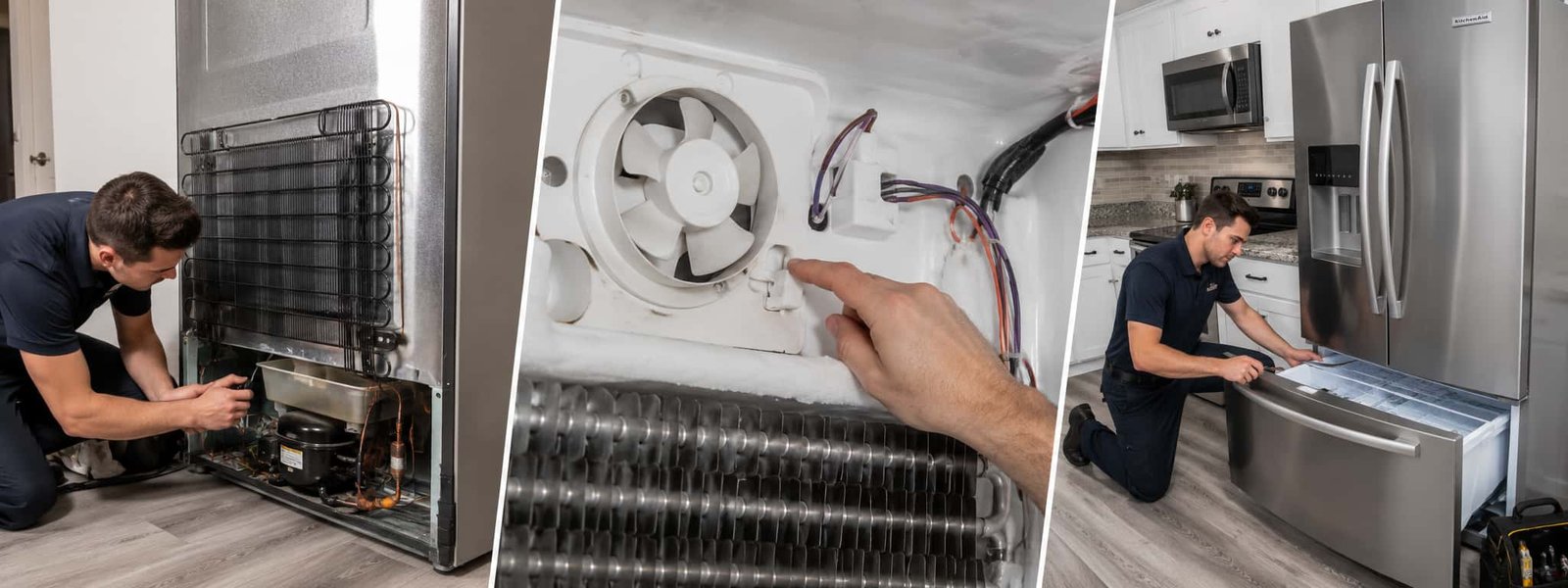
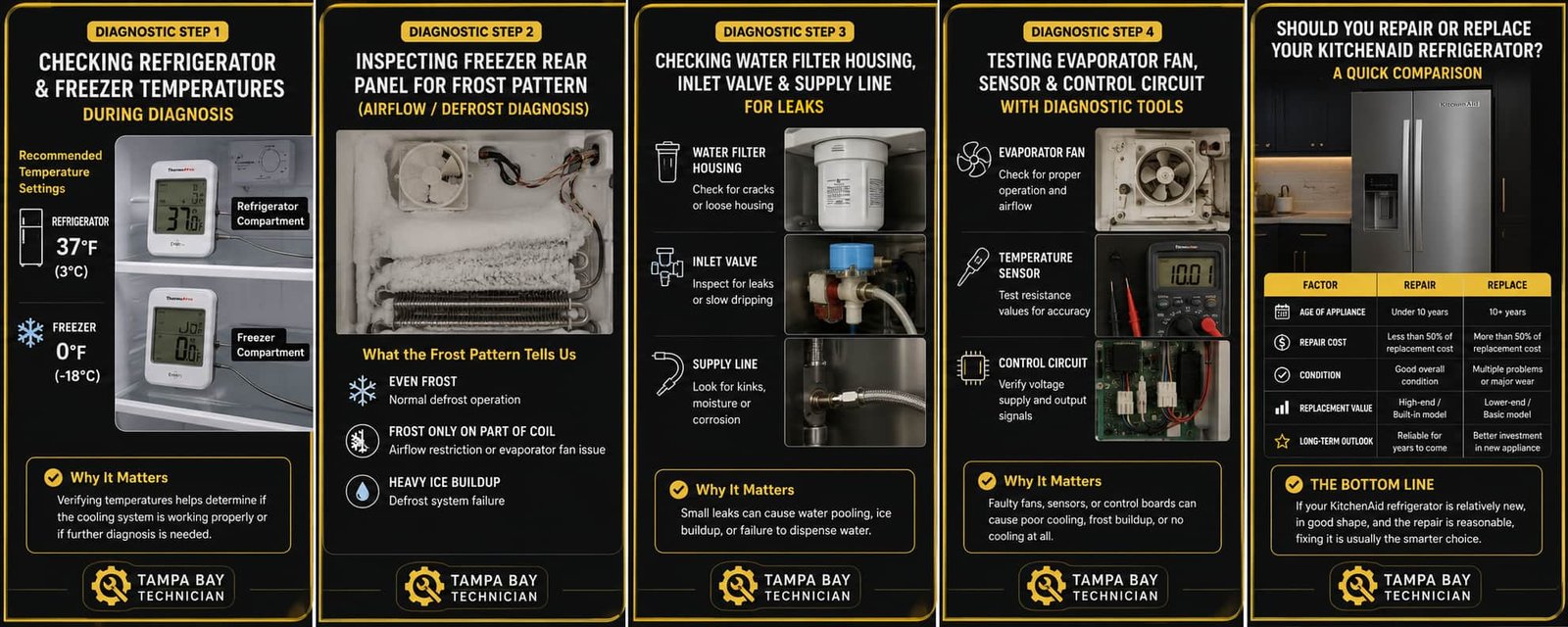
When I diagnose a KitchenAid refrigerator, I start with temperatures, airflow, frost pattern, fan operation, door sealing, water pressure, and the exact model number. I do not start by ordering the part most often named online. Two identical symptoms can have different causes. I have fixed a warm refrigerator by replacing an evaporator fan, and I have fixed the same complaint by moving one bag away from a return vent. Clicking can also mean different things. One brief click may be a normal valve. A repeating click-hum-click while temperatures rise may be a compressor-start problem. This guide covers many French-door, side-by-side, counter-depth, and built-in KitchenAid models. Designs vary, so match resets and codes to the model number inside the cabinet.KitchenAid Refrigerator Symptom Checker
Use this table to decide what to check first, not which part to buy. The same symptom can come from several failures.| Symptom | What I check first | Safe DIY? | Needs a technician? |
|---|---|---|---|
| Both sections are warm | Cooling setting, power, condenser airflow, compressor and fans | Settings, vents, basic coil cleaning | Yes, if temperature does not improve |
| Freezer cold, refrigerator warm | Evaporator fan, frost buildup, damper and return airflow | Clear visible vents | Usually |
| Repeated clicking with no cooling | Start device, inverter, compressor current and supply voltage | Power reset only | Yes |
| Water under refrigerator | Supply line, filter housing, inlet valve, drain pan and defrost drain | Inspect visible tubing and filter | Yes, if source is hidden |
| Ice maker not making ice | Freezer or ice-box temperature, filter, fill tube, valve and ice maker | Check switch, filter and visible ice jam | Often |
| Water dispenser is slow or dead | Filter installation, water pressure, frozen line, valve and dispenser switch | Replace or reseat filter | If flow stays weak |
| Heavy frost behind drawers | Door sealing, defrost heater, sensor and control | Check door closure | Usually |
| Lights out but refrigerator cools | Door switch, LED module, wiring and LED driver | Check door switch area | Yes, for electrical testing |
Why KitchenAid Refrigerators Are Different
KitchenAid uses several refrigerator platforms. A French-door model with an ice maker in the ceiling is not diagnosed like a side-by-side unit, and a built-in may place major components above the doors. Some models use separate evaporators, variable-speed compressors, several thermistors, electronic dampers, LED drivers, and communicating controls. That improves control but gives one symptom several possible causes. Counter-depth models are easier to block with food. French-door models can have ice-box airflow trouble while the freezer works. Built-ins require different access, ventilation checks, and repair-versus-replacement math. That is why I use the exact service sheet and live measurements. A code or test sequence from another KitchenAid model can look right and still point to the wrong repair.10 Common KitchenAid Refrigerator Problems and What They Usually Mean
1KitchenAid Refrigerator Not Cooling
Problem description: Both sections are warm, ice is melting, or the display works but the cabinet is not removing heat. Lights alone do not prove the cooling system is running. Why it happens: Cooling may be off, airflow may be restricted, or a fan, sensor, start device, inverter, control, compressor, or sealed system may have failed. What I usually find: I confirm temperatures and compressor operation first. I have seen identical no-cooling complaints caused by a dirty condenser, a bad inverter, and a refrigerant leak. Guessing from the symptom is expensive. Safe things homeowners can check: Confirm cooling is on, demo mode is off, vents are clear, doors close, and accessible condenser areas are clean. Unplug the refrigerator before cleaning. When not to keep troubleshooting: Stop if the compressor is extremely hot, it repeatedly tries to start, temperatures keep rising, a breaker trips, or you smell overheated wiring.Safe to check yourself
- Cooling setting and showroom mode
- Blocked interior air vents
- Door closure and visible gasket gaps
Requires professional repair
- Compressor or inverter testing
- Refrigerant leak or sealed-system work
- Control board voltage testing
If both compartments stay warm after these checks, arrange diagnosis. Our same-day refrigerator repair service is available when scheduling and parts allow.
2Freezer Cold but Refrigerator Warm
Problem description: Frozen food stays hard while milk, drinks, and produce become too warm. The refrigerator looks half-working because most of the cold remains in the freezer. Why it happens: A blocked vent, failed evaporator fan, iced evaporator, stuck damper, bad thermistor, or defrost fault can stop cold air from reaching the fresh-food section. What I usually find: I inspect the rear freezer panel and listen for the fan. In Wesley Chapel I found a failed fan; the next day in Riverview, the same symptom came from a return vent covered by frozen food. Safe things homeowners can check: Move food away from supply and return vents, confirm the drawer closes fully, and look for heavy frost. Do not remove panels or chip ice. When not to keep troubleshooting: Stop if the fan hits ice, the rear wall is snow-covered, or the refrigerator remains above 40°F. Lowering the freezer setting can make frost worse.Safe to check yourself
- Clear supply and return vents
- Rearrange tightly packed food
- Inspect the visible rear wall for frost
Requires professional repair
- Evaporator fan replacement
- Defrost heater or sensor testing
- Damper or control diagnosis
If clearing the vents changes nothing, the fan, damper, defrost system, sensors, and cooling circuit need testing.
3KitchenAid Refrigerator Running Constantly
Problem description: The refrigerator seems to run all day or the cabinet sides feel warm. Long cycles can be normal on variable-speed models, but not when temperatures drift or heat becomes excessive. Why it happens: Hot rooms, frequent openings, a large food load, dirty condenser surfaces, leaking gaskets, blocked airflow, iced coils, weak fans, bad sensing, or sealed-system trouble can keep it running. What I usually find: In Clearwater and St. Petersburg, humidity and patio traffic add a surprising heat load. I also find units squeezed into cabinets with poor ventilation, especially built-ins with dusty upper grilles. Safe things homeowners can check: Measure both temperatures, clean accessible condenser areas, wipe the gaskets, remove door obstructions, and make sure the refrigerator is not beside a strong heat source. When not to keep troubleshooting: Call for service if it runs nearly nonstop but cannot hold safe temperature, the cabinet becomes unusually hot, or the condenser fan does not run with the compressor.Safe to check yourself
- Actual temperature with a thermometer
- Door gasket cleanliness
- Cabinet ventilation and room heat
Requires professional repair
- Fan speed and voltage testing
- Thermistor resistance testing
- Control board diagnosis
Stable temperatures may mean normal long cycles. Constant running with warm food needs diagnosis.
4KitchenAid Refrigerator Making Noise or Clicking
Problem description: Buzzing, popping, gurgling, and brief clicks can be normal. New grinding, a fan striking ice, loud electrical buzzing, or repeated click-hum-click cycles with poor cooling are not. Why it happens: Normal sounds come from refrigerant, ice, valves, fans, and cabinet movement. Problem sounds may come from ice around a fan, loose tubing, worn bearings, a start device, inverter, or compressor. What I usually find: Timing matters. A click during water fill is different from a click every three minutes while temperatures rise. I ask when it starts, where it is loudest, and whether opening a door changes it. Safe things homeowners can check: Remove items from the top, check cabinet contact, inspect the visible water line, and record a short video near the freezer, top, and lower rear. When not to keep troubleshooting: Stop if the sound comes with no cooling, burning odor, a tripped breaker, or repeated compressor-start attempts. Do not open energized electrical covers.Safe to check yourself
- Items vibrating on top
- Cabinet contact and leveling
- Water line tapping a wall
Requires professional repair
- Evaporator or condenser fan repair
- Start device or inverter testing
- Compressor diagnosis
If a new noise repeats and cooling changes, have it traced before the repair becomes more expensive.
5KitchenAid Refrigerator Leaking Water
Problem description: Water may appear under the refrigerator, behind it, below the crisper drawers, around the filter, near the dispenser, or inside the freezer. Location and timing narrow the cause. Why it happens: Common causes are a loose supply connection, cracked tube, damaged or crooked filter, leaking inlet valve, blocked defrost drain, overflowing ice maker, cracked pan, or door-seal condensation. What I usually find: Leaks after a filter change often come from seating or seal damage. Water behind the unit points toward the supply or valve; water under drawers usually sends me toward drainage or internal condensation. Safe things homeowners can check: Shut off the water if the leak is active, dry the area, inspect visible tubing, reseat the correct filter, and watch whether water appears during dispensing or ice fill. When not to keep troubleshooting: Stop using water and ice if moisture reaches wiring, cabinetry, hardwood, or the valve area. Never pull out a heavy built-in without proper equipment.Safe to check yourself
- Shut off the water supply
- Reseat and inspect the filter
- Inspect visible tubing and fittings
Requires professional repair
- Inlet valve replacement
- Internal water-line repair
- Defrost drain clearing behind panels
If the source is hidden or the leak returns, trace it before flooring or cabinets are damaged.
6KitchenAid Refrigerator Ice Maker Not Working
Problem description: The bin stays empty, cubes are small, production slows, water never enters the mold, or cubes freeze in the mold but never harvest. Why it happens: The ice maker may be off, too warm, starved by a filter or valve, blocked by a frozen fill tube, or affected by an ice-box fan, motor, heater, thermistor, wiring, or control fault. What I usually find: I check temperature before replacing the ice maker. A warm ice compartment makes a new assembly fail exactly like the old one. A dry mold suggests a fill problem; trapped cubes suggest a harvest problem. Safe things homeowners can check: Confirm the on/off setting, water supply, filter condition, bin position, and freezer temperature near 0°F. Remove only loose ice. Never force the ejector fingers. When not to keep troubleshooting: Stop if the fill tube freezes again, water leaks near wiring, the motor clicks without moving, or a model-specific ice maker code returns.Safe to check yourself
- Ice maker on/off setting
- Water shutoff and filter age
- Bin seating and loose ice jams
Requires professional repair
- Ice maker motor or heater repair
- Valve and fill-tube diagnosis
- Ice-box fan testing
If the compartment is cold and water supply is good, use model-specific diagnostics instead of replacing multiple parts.
7Water Dispenser or Water Filter Problems
Problem description: Water becomes slow, stops, spurts after a filter change, tastes odd, leaks around the housing, or the filter light stays on. Why it happens: A clogged, incorrect, damaged, or poorly seated filter can restrict flow. Other causes include trapped air, low house pressure, a kinked or frozen line, inlet valve, paddle switch, lock, or control fault. What I usually find: I ask whether the symptom began immediately after the filter change. If it did, I inspect fit and seals before touching electronics. Overtightening some filter styles can distort the seal. Safe things homeowners can check: Unlock the dispenser, reinstall the exact filter straight, flush it as directed, fully open the shutoff valve, and inspect the visible hose for a kink. When not to keep troubleshooting: Stop if the filter head is cracked, water reaches electrical parts, the valve chatters without flow, or tubing appears frozen inside the door. Do not use uncontrolled heat.Safe to check yourself
- Dispenser lock setting
- Correct filter and installation
- Visible supply-line kink
Requires professional repair
- Filter-head replacement
- Inlet-valve testing
- Frozen internal line diagnosis
If a correct new filter does not restore flow, test pressure, the valve, and the internal line.
8KitchenAid Refrigerator Frosting Up
Problem description: Frost covers food, forms around a drawer or ice box, coats the rear freezer panel, or quickly returns after a manual thaw. Why it happens: Humid air enters through an open door, torn gasket, misaligned drawer, or bad mullion. Hidden heavy frost can also come from a failed defrost heater, thermistor, wiring path, or control. What I usually find: Florida humidity exposes small sealing problems quickly. In Sarasota and Bradenton, a freezer bag blocking the drawer is common. A uniformly snow-covered rear panel points more toward a defrost failure. Safe things homeowners can check: Remove door obstructions, clean gaskets, verify the French-door center flap closes, and photograph the frost pattern before unplugging the refrigerator. When not to keep troubleshooting: Never chip ice with a tool or use a flame, heat gun, or high heat. If the fan hits ice or frost returns, the defrost system needs testing.Safe to check yourself
- Door and drawer obstruction
- Gasket cleaning and visual inspection
- French-door mullion position
Requires professional repair
- Defrost heater testing
- Evaporator thermistor testing
- Control-board diagnosis
If airflow disappears again after thawing, diagnose it before ice damages the fan or food.
9Door Not Sealing, Condensation, or Food Freezing
Problem description: A door drifts open, moisture forms around the frame, the center divider sweats, food freezes near a vent, or one gasket corner does not touch the cabinet. Why it happens: The cabinet may be out of level, a hinge or door may sag, bins may interfere, the gasket may be dirty or torn, the mullion may miss its track, or airflow may be blocked. What I usually find: Many “bad gasket” calls are alignment or bin problems. I also see refrigerators leaning forward so a loaded door opens. Food freezing beside one outlet is usually placement or airflow before thermostat failure. Safe things homeowners can check: Clean the gasket, remove bin interference, use a paper strip to compare seal resistance, move sensitive food away from vents, and change temperature only one step at a time. When not to keep troubleshooting: Stop if the door sags, a hinge is loose, a built-in panel binds, or the gasket is torn. Large built-in doors are too heavy for casual adjustment.Safe to check yourself
- Clean gasket contact surfaces
- Remove shelf and bin interference
- Paper-strip seal check
Requires professional repair
- Door or hinge alignment
- Built-in panel adjustment
- Gasket replacement and fitting
If cleaning and rearranging do not restore an even seal, check alignment before ordering a gasket.
10Error Codes, Dead Controls, or LED Lights Not Working
Problem description: The display may show PO, an F-code, a filter or temperature alert, “Cooling Off,” or a flashing symbol. Buttons may freeze or several LED lights may fail. Why it happens: Power interruption, communication loss, a thermistor, fan, ice maker, wiring connection, LED module, driver, interface, or main board can create these symptoms. What I usually find: I separate alerts from faults. PO usually reports lost power; a filter light is maintenance. A returning F-code needs the exact model service sheet. For dark lights, I test the switch and low-voltage circuit first. Safe things homeowners can check: Photograph the display, confirm cooling is on, check panel lock and door-switch movement, then try one power reset. Do not use service-mode steps from another model. When not to keep troubleshooting: Stop if the code returns, the panel reboots, lights flicker with electrical noise, a breaker trips, or cooling changes. Control boards carry line voltage.Safe to check yourself
- Photograph the display
- Check control lock and cooling setting
- Perform one correct power reset
Requires professional repair
- Main board or interface testing
- LED module and driver diagnosis
- Sensor and communication testing
If the code returns after one reset, keep the photo and arrange diagnosis. Stored faults and live readings improve first-visit accuracy.
KitchenAid Refrigerator Repair Cost in 2026
KitchenAid’s published out-of-warranty figures are broad averages. Actual cost depends on the model, access, failed part, and whether the job involves a built-in or sealed system. These are planning ranges for parts and labor, not a quote. Built-in access, discontinued parts, cabinet work, and multiple failures can increase the total.| Repair | Typical total cost | Usually worth repairing? | Same-day possible? |
|---|---|---|---|
| Drain clearing or minor leak repair | $150 to $325 | Yes | Often |
| Water inlet valve or filter housing | $200 to $450 | Yes | Often, if part is stocked |
| Door gasket | $220 to $500 | Usually | Depends on model and part |
| Evaporator or condenser fan | $250 to $550 | Usually | Often |
| Defrost heater, sensor, or related repair | $275 to $650 | Usually | Sometimes |
| Ice maker assembly or ice-box component | $300 to $700 | Usually | Depends on part |
| LED module or lighting circuit | $175 to $450 | Usually | Often |
| Main control board or user interface | $350 to $900 | Often | Depends on model programming and part |
| Compressor or sealed-system repair | $800 to $2,000+ | Case by case; often yes on built-ins | Usually requires parts and return visit |
KitchenAid Refrigerator Error Code Table
KitchenAid does not use one universal code list. Public support pages group several F-codes, while the exact circuit and test procedure come from the service sheet for your model. Ice maker codes are also model-specific. Some French-door platforms use service test 56 with E0 through E5. Apply those meanings only when your model sheet shows that test.| Code or display | What it means | Can reset help? | Needs service? |
|---|---|---|---|
| PO | Power outage or power interruption alert | Acknowledge or reset after power is stable | Only if it repeats without a known outage |
| Cooling Off / Showroom | Interior lights may work while cooling is disabled | Turn cooling back on using model instructions | If the setting will not stay on |
| F3 E1, F3 E2, F3 E4, F3 E8, F3 E9, F3 EC | Model-specific fault | Try one-minute reset | Yes, if it returns |
| F4 E1, F6 E1 | Model-specific fault | Try one-minute reset | Yes, if it returns |
| F8 E1, F8 E2, F8 E3, F8 E8, F8 EC | Model-specific fault | Try one-minute reset | Yes, if it returns |
| Temperature Alarm / Door Ajar | High temperature or open door | Close doors; allow recovery | If the alarm continues with doors sealed |
| H2O / Replace Filter | Filter-status reminder | Replace filter; reset status | If flow or leaking problem remains |
| Ice maker E1 | Ice compartment too warm on certain models | Usually not | Usually |
| Ice maker E2 | Harvest motor lost position on certain models | Clear loose obstruction only | If code remains |
| Ice maker E3 | Ice-mold heater timeout on certain models | Usually not a lasting fix | Yes |
| Ice maker E4 | Dry cycles; possible valve or frozen fill tube | Check water supply and filter | If no fill occurs |
| Ice maker E5 | Possible ice-mold thermistor fault | Usually not | Yes |
How to Reset a KitchenAid Refrigerator
A reset can clear a temporary display or communication fault after a power interruption. It cannot repair a failed fan, valve, sensor, control, compressor, or sealed system.- Photograph the code, temperatures, and display before clearing them.
- Switch power off at the breaker or unplug the unit. Do not pull a built-in out just to reach a plug.
- Leave power off for at least one full minute, or longer if the model manual specifies it.
- Restore power and confirm cooling is on and showroom mode is off.
- Write down any code that returns. Move food if temperature remains above 40°F.
How to Reset the KitchenAid Ice Maker
Confirm the ice maker is on. Use its reset or test button only if the owner manual shows one. Otherwise, one refrigerator power cycle is safer than forcing ejector arms or jumping test points.How to Reset the Water Filter Light
Install and seat the correct filter first, then use the model-specific control sequence. Resetting the light without replacing a restricted filter only clears the reminder.KitchenAid Refrigerator Maintenance Checklist
Maintenance cannot prevent every electronic or sealed-system failure, but it reduces avoidable heat, moisture, airflow, and water problems.Every Month
- Check both temperatures with an appliance thermometer.
- Wipe spills before they block drains or bins.
- Keep food clear of air vents.
Every Three to Six Months
- Clean and dry door gaskets.
- Vacuum accessible condenser dust if the manual allows it.
- Inspect visible water tubing and fittings.
About Every Six Months, or as Needed
- Replace the correct filter when flow, taste, or the indicator calls for it.
- Flush the system after filter replacement.
- Reset filter status using model instructions.
Once a Year
- Inspect door alignment and gasket contact.
- Check that the cabinet is level.
- Inspect built-in grilles for blocked airflow.
Is a KitchenAid Refrigerator Worth Repairing?
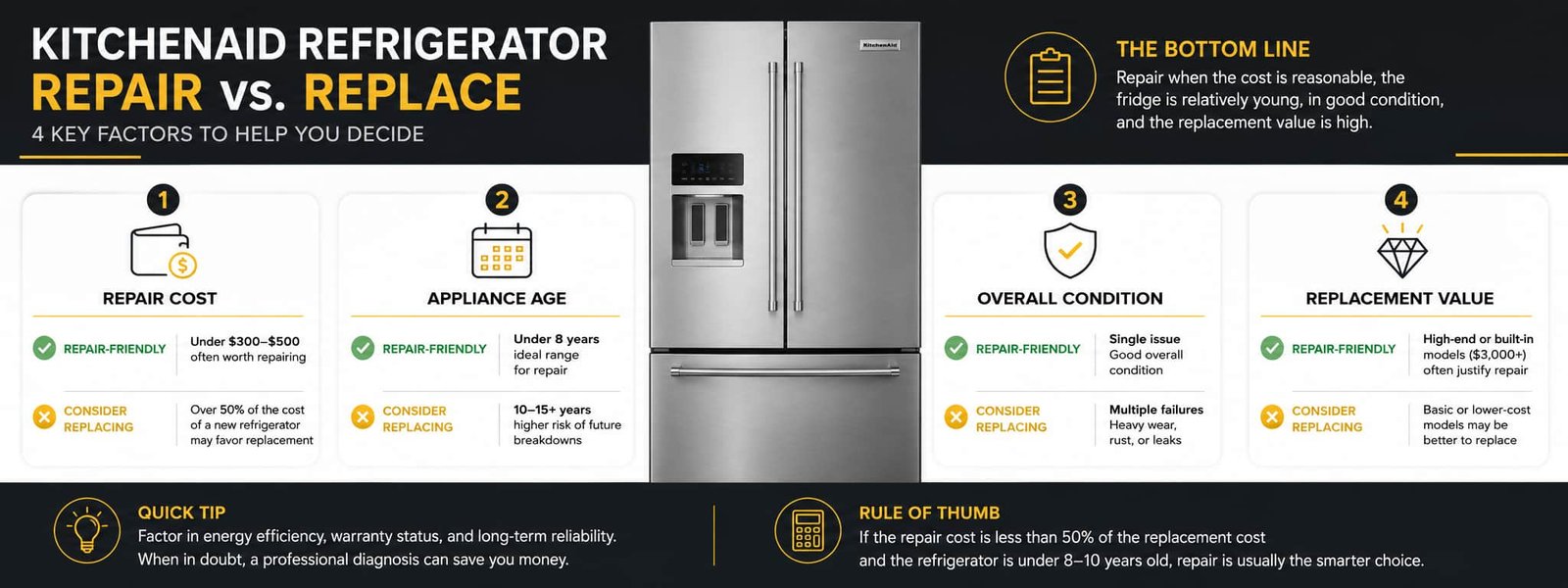
Often, yes. I compare age, model type, condition, repair history, parts availability, and the full installed replacement cost. The usual “50 percent rule” is only a rough filter.Repair usually makes sense when:
- Cabinet, liner, doors, and alignment are sound.
- The failure is an isolated fan, valve, drain, gasket, sensor, ice maker, or control.
- It is a built-in or premium counter-depth model.
- Parts are available and structural damage is absent.
Replacement deserves serious consideration when:
- An older freestanding unit needs costly sealed-system work and has other wear.
- Cabinet, liner, doors, or insulation are badly damaged.
- Several expensive controls or cooling components failed together.
- Parts are scarce and repair approaches installed replacement cost.
KitchenAid Refrigerator Repair Across Tampa Bay
In Tampa, I often see airflow trouble in heavily loaded family refrigerators. In St. Petersburg and Clearwater, humidity makes small gasket leaks easier to spot. In Largo, filter and drain leaks can reach flooring before cooling changes. We also service KitchenAid French-door, counter-depth, and built-in refrigerators in Wesley Chapel, Riverview, Sarasota, and Bradenton. Same-day appointments are available when the route and schedule allow. For brand-specific service details, use our future KitchenAid appliance repair page.KitchenAid Refrigerator Troubleshooting FAQ
What is the most common problem with a KitchenAid refrigerator?
Why is my KitchenAid refrigerator not cooling but the lights are on?
Why is the KitchenAid freezer cold but the refrigerator warm?
How do I reset a KitchenAid refrigerator?
Why is my KitchenAid refrigerator clicking?
Why is my KitchenAid refrigerator leaking water?
Why is my KitchenAid ice maker not making ice?
Can a bad water filter stop a KitchenAid ice maker?
Why does my KitchenAid refrigerator keep frosting up?
Why are the LED lights not working in my KitchenAid refrigerator?
How much does KitchenAid refrigerator repair cost?
Is it worth repairing a KitchenAid refrigerator?
Do KitchenAid refrigerator error codes tell me which part to replace?
How long should I wait after resetting a KitchenAid refrigerator?
Technical References Checked
Model-specific instructions always take priority. This guide was cross-checked against current KitchenAid Product Help pages, KitchenAid technical sheets for selected French-door platforms, KitchenAid’s service-cost information, and federal cold-food safety guidance.Still Not Sure What Failed?
If you have already checked the settings, vents, filter, doors, and visible water connections but the symptom has not changed, it is probably time to have the refrigerator diagnosed properly. We service KitchenAid freestanding, French-door, counter-depth, and many built-in refrigerators across Tampa Bay. Same-day service is available when the schedule allows. Eligible completed repairs include a 90-day warranty on labor and installed parts. You can call and describe the symptom, or schedule online without taking the refrigerator apart first.