12 Appliance Problems We Fix Every Week in Pasco County: Real Technician Notes by Appliance and Brand (2026)
A practical field guide to the refrigerator, ice maker, washer, dryer, dishwasher, oven, cooktop, microwave, freezer, wine cooler, range hood, and garbage disposal problems that keep showing up on local service calls.
Quick Answer
The appliance problems I see most often in Pasco County are refrigerators that stop cooling, ice makers that quit or freeze up, washers that will not drain or spin, dryers that run without heat, dishwashers that leave standing water, and ovens that no longer hold the right temperature. I also get regular calls for leaks, loud noises, control-panel faults, door-seal problems, weak water flow, and appliances that stop after a power interruption. Homeowners can safely check power, settings, filters, visible hoses, door closure, airflow, and simple blockages. Internal electrical testing, gas work, sealed refrigeration systems, and microwave repairs should be left to a trained technician.What This Guide Is, and What It Is Not
I do not diagnose appliances by brand reputation or by the first search result that names a part. I start with the symptom, the model number, the installation, and what the appliance is actually doing during a cycle. That matters because two homeowners can describe the same problem and need completely different repairs. A washer that will not drain may have a coin in the pump, a kinked hose, a failed drain pump, damaged wiring, or a control that never sends power to the pump. Replacing the pump without testing can waste money and leave the washer exactly where it started. This article is based on the calls that repeat across New Port Richey, Hudson, Port Richey, Holiday, Trinity, Land O’ Lakes, Wesley Chapel, Zephyrhills, and nearby Pasco County communities. It is not a failure-rate ranking and it does not claim every Samsung, LG, Whirlpool, GE, Maytag, KitchenAid, Bosch, Frigidaire, Electrolux, Kenmore, Sub-Zero, Viking, Thermador, JennAir, Monogram, or Miele appliance develops the same problem. Think of it as the conversation I would have with you while standing next to the machine. I will explain what the symptom usually means, what you can check safely, what makes me stop the appliance, and when a repair is normally worth considering.Pasco County Appliance Symptom Checker
Use this table to decide what to check first. Do not use it as a shopping list for parts. A symptom points us toward a system, not always one failed component.| Symptom | What I check first | Safe homeowner check | Stop using it? |
|---|---|---|---|
| Refrigerator warm, lights on | Temperatures, fans, frost pattern, compressor operation, condenser airflow | Settings, blocked vents, door closure, visible dust | Protect food if above 40°F |
| Freezer cold, refrigerator warm | Evaporator fan, return vent, damper, frost and defrost system | Move food away from vents | Not immediately, but monitor food temperature |
| Ice maker stopped | Temperature, filter, water pressure, fill tube, valve, ice maker cycle | Confirm switch, filter, water supply, loose ice jam | Stop if water is leaking |
| Washer will not drain | Drain hose, pump filter, pump impeller, wiring, pressure sensing | Check hose and accessible filter for your model | Yes, if water is leaking or wiring smells hot |
| Washer bangs during spin | Load balance, leveling, suspension, shocks, bearings and basket movement | Redistribute load and check level | Yes, if the tub hits the cabinet |
| Dryer runs but has no heat | Power supply, airflow, heater or igniter, fuse, thermostat and controls | Check both breakers and exterior vent airflow | Yes, if it smells hot or airflow is weak |
| Dishwasher has standing water | Filter, drain path, disposal connection, hose, pump and control | Clean filter and check sink or disposal | Yes, if it leaks or smells electrical |
| Oven heats slowly or unevenly | Element or igniter output, sensor, calibration, voltage, airflow and control | Confirm mode, rack position, visible element damage | Yes, for gas odor, sparking or runaway heat |
| Microwave runs but does not heat | Door interlocks, high-voltage circuit, magnetron and controls | Confirm it is not in timer or demo mode | Yes. Do not remove the cover |
What Changes Appliance Diagnosis in Pasco County
Florida conditions matter, but I never use the weather as a shortcut diagnosis. Heat, humidity, water quality, installation, and power events can change how a problem shows up. They do not automatically prove what failed.Hot garages and utility spaces
A refrigerator or freezer in a hot garage has to reject heat into hotter air. A dryer in a tight laundry closet can recirculate heat if the room lacks airflow. When I work in Hudson or Port Richey and the appliance sits against a hot exterior wall, I check the installation temperature and clearances before blaming an electronic control.Humidity entering through doors and seals
Moist air becomes visible frost or condensation when it reaches cold surfaces. A slightly misaligned refrigerator door, torn gasket, weak mullion, or overloaded freezer drawer may create more frost here than it would in a dry climate. The humidity did not break the refrigerator. It made an air leak more expensive.Water conditions vary by neighborhood and supply
Some homes show heavy scale on dishwasher filters, spray arms, refrigerator fill screens, and ice maker parts. Other homes have a softener or different utility supply and show almost none. Pasco County uses separate water systems and many properties use wells, so I look at the actual deposits in the appliance instead of making one county-wide assumption.Power interruptions and surges
After storms or a brief outage, I get calls about blank displays, flashing codes, cooling-off modes, and controls that will not respond. A reset may restore a temporary communication problem. If the code returns, or the appliance stays dead, the next step is voltage and component testing. Repeated resets can hide the symptom without fixing the cause.How I Use Brand Information Without Guessing
Brand and model matter because the internal design changes. They tell me where to look and which service tests are available. They do not let me skip testing.Samsung
On refrigerators I pay close attention to ice-box temperature, frost, fan airflow, drain paths, filters, and model-specific ice maker service procedures. On laundry units I separate drain, balance, heater, and control symptoms before naming a part.LG
For weak refrigerator cooling I check actual temperatures, airflow, fan operation, condenser condition, compressor behavior, and sealed-system performance. On front-load washers I inspect the drain path, pump filter, door boot, and load balance.Whirlpool, Maytag and Amana
These brands share some platforms, but the model still controls the diagnosis. Washer calls often begin with the drain hose, pump filter, lid or door sensing, suspension, and stored error history. Dryer no-heat calls begin with power and airflow.GE and Monogram
I see a wide mix of refrigerator, dishwasher, wall oven, range, and cooktop designs. On cooking appliances, the symptom may come from an element, igniter, sensor, connection, user interface, or main control, so temperature and current tests matter.Frigidaire and Electrolux
Model-specific airflow, defrost, ice maker, washer drain, dryer heat, and oven temperature checks are more reliable than replacing the component most often blamed online. I also inspect connectors closely when heat or moisture has been present.KitchenAid and Bosch
Dishwasher drying behavior differs by design. Some systems depend heavily on rinse aid, loading, condensation drying, fans, or specific dry options. I confirm the intended operation before calling normal moisture a heating-element failure.Kenmore
Kenmore is a label used on appliances built by different manufacturers. The model number is essential because it identifies the platform, parts, wiring, and diagnostic procedure.Sub-Zero, Viking and Thermador
Built-in refrigeration and premium cooking equipment require different access, ventilation checks, part sourcing, and repair economics. I do not treat a built-in refrigerator like a standard freestanding unit.JennAir, Miele and other premium brands
Integrated panels, stacked components, specialty controls, and model-specific error histories can add diagnostic time. The right first step is identifying the exact model and installation, not forcing a generic reset.1Refrigerator Not Cooling, or Freezer Cold but Refrigerator Warm
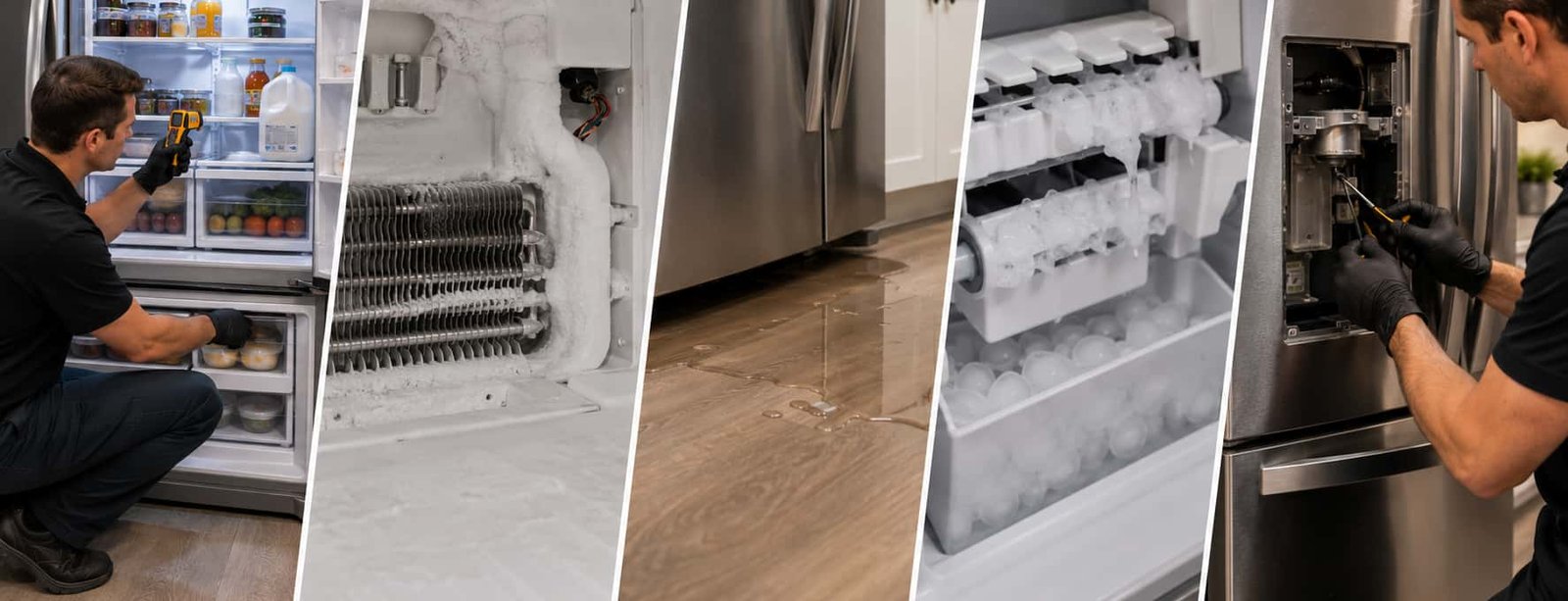
What the homeowner notices: Milk feels warm, produce spoils early, ice cream softens, or the refrigerator section warms while the freezer still makes ice. The lights and display may work normally. Why it happens: Both compartments warm can point to lost compressor operation, fan failure, a control problem, dirty condenser airflow, a sealed-system issue, or the refrigerator being placed in cooling-off mode. A cold freezer with a warm fresh-food section usually shifts my attention toward airflow, an evaporator fan, a blocked return, an iced evaporator, a damper, or temperature sensing. What I usually find: I have repaired this complaint by replacing a failed fan, but I have also fixed it by removing food packed against a return vent. On another call, the rear freezer panel looked normal from the front, yet the evaporator behind it was buried in frost because the defrost system had stopped cycling. Identical symptom, different cause. Safe things to check: Set the refrigerator near 37°F and freezer near 0°F, confirm cooling is on, move food away from vents, close each door on a sheet of paper to feel for seal resistance, and listen for fans. Clean accessible condenser surfaces only as the model instructions allow.Safe to check yourself
- Temperature settings and cooling mode
- Food blocking supply or return vents
- Door gasket contact and drawer closure
- Visible dust around accessible airflow areas
Requires professional diagnosis
- Evaporator or condenser fan testing
- Defrost heater, sensor, damper, or control tests
- Compressor, inverter, relay, or current testing
- Refrigerant leak or sealed-system work
If temperatures keep rising after the basic checks, move perishable food and arrange proper diagnosis. Our refrigerator repair service covers standard, counter-depth, French-door, and many built-in models.
2Ice Maker Failure, Water Leaks, Frost, and Weak Water Flow
What the homeowner notices: The bin stays empty, cubes become small, the ice maker freezes into a block, the dispenser slows down, water collects under drawers, or frost spreads around the freezer door. Why it happens: Ice production depends on temperature, water pressure, filter condition, a clear fill tube, valve operation, ice maker cycling, and model-specific fans or sensors. Leaks can come from the supply line, filter housing, valve, drain, ice maker, dispenser path, or condensation caused by a door that does not seal. What I usually find: A working water dispenser does not prove the ice maker circuit is fine. Many refrigerators use separate valve paths. I also see homeowners replace an ice maker when the compartment is simply too warm to harvest ice. The new assembly then appears “bad” for the same reason. Safe things to check: Confirm the ice maker is on, reseat the bin, verify the water valve is open, inspect the filter for age and correct installation, remove only loose ice, and look at visible tubing. If the filter was just changed, flush it according to the manufacturer instructions.Safe to check yourself
- Ice maker switch and bin position
- Filter age and correct seating
- Water shutoff and visible supply line
- Door closure and loose frost obstruction
Requires professional diagnosis
- Inlet valve and ice maker current tests
- Frozen fill tube that returns after thawing
- Hidden defrost drain or cabinet leak
- Ice-box fan, sensor, wiring, or control fault
Shut off the refrigerator water supply if the leak is active. If the compartment is cold and the water supply is good but ice production does not return, the next step is model-specific testing, not another random part.
3Washer Not Draining, Stopping Mid-Cycle, or Showing a Long-Drain Code
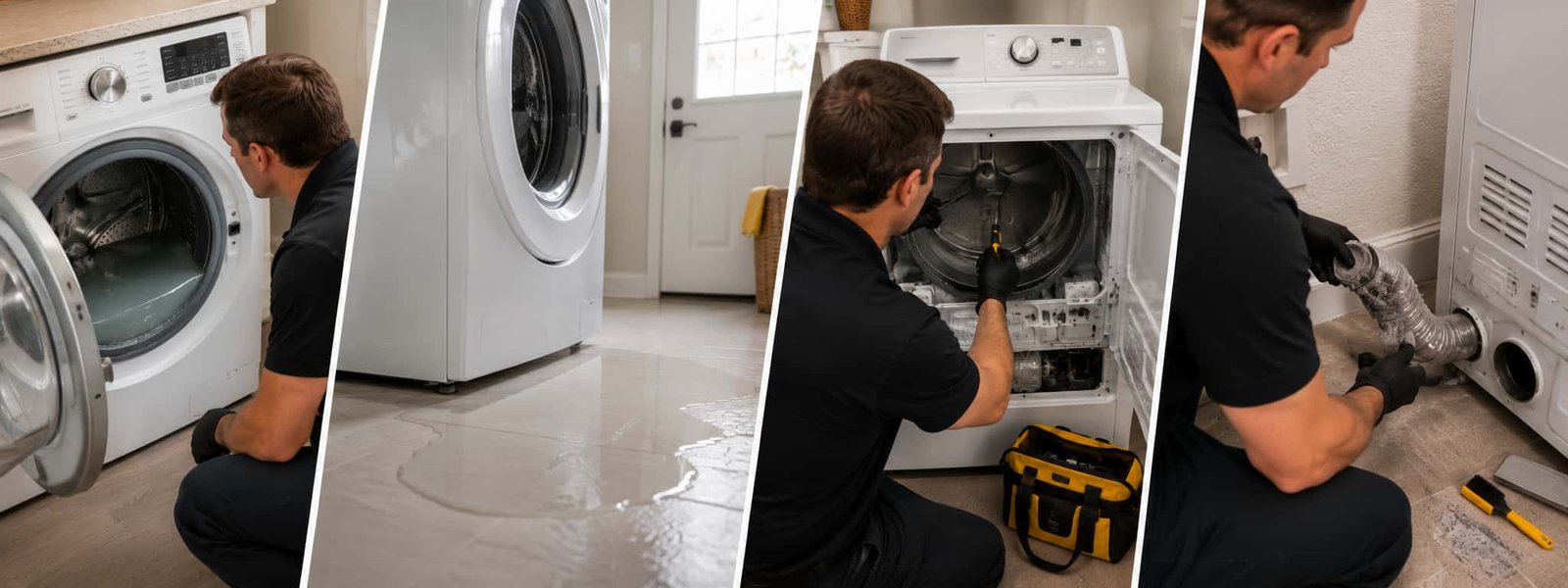
What the homeowner notices: Water remains in the tub, the door stays locked, clothes are soaked, the washer hums without draining, or a code such as F9E1 appears on certain Whirlpool-family models. Why it happens: The drain hose may be kinked, installed too deep, blocked, or too high. A front-load pump filter may contain coins, hair pins, lint, socks, or pet debris. The pump impeller can break, wiring can fail, a pressure system can misread the water level, or the control may not power the pump. What I usually find: Small objects are common, but I do not assume every drain problem is a clog. I have opened a clean filter and found a pump that received voltage but could not move water. On another machine, the pump was fine and the drain hose had been pushed so far down the standpipe that water siphoned back into the washer. Safe things to check: Unplug the washer, inspect the visible drain hose for kinks, confirm the standpipe is not overflowing, and clean the accessible pump filter only if the owner manual provides a homeowner procedure. Prepare towels and a shallow pan because trapped water can release quickly.Safe to check yourself
- Visible hose kinks or standpipe backup
- Accessible pump filter, following the manual
- Load items trapped around the door boot
- One power reset after recording the code
Requires professional diagnosis
- Pump voltage, resistance, and impeller condition
- Internal hose or tub obstruction
- Pressure sensor and control testing
- Door lock that will not release safely
If the filter and hose are clear but the washer still will not drain, our washer and dryer repair service can test the entire drain circuit instead of replacing the pump by guesswork.
4Washer Shaking, Banging, Leaking, or Refusing to Spin
What the homeowner notices: The machine walks across the floor, the tub hits the cabinet, one heavy item stays soaked, the washer repeatedly tries to rebalance, or water appears near the front or underneath. Why it happens: A single absorbent item, an overloaded drum, unlevel feet, shipping bolts left in a new front loader, worn suspension rods, weak shocks, bearing wear, a loose basket, motor or drive problems, and lid or door sensing can all affect spin. Leaks may come from hoses, a door boot, dispenser path, pump, tub seal, or over-sudsing. What I usually find: A load issue is easy to correct. A tub that physically strikes the cabinet is different. I once found a washer that behaved perfectly empty but lost control with towels because two suspension rods had weakened. Another “leaking washer” was using too much non-HE detergent, creating foam that climbed into places water should never reach. Safe things to check: Stop the cycle, redistribute the load, run smaller balanced loads, confirm the machine is level and all feet are firm, and inspect visible hoses. For a recently installed front loader, verify the shipping materials were removed according to the installation guide.Safe to check yourself
- Load size and even distribution
- Level feet and solid flooring
- Correct HE detergent amount
- Visible inlet and drain hose connections
Requires professional diagnosis
- Suspension rods, shocks, bearings, and basket play
- Door boot, pump, tub seal, or internal hose leak
- Drive motor, belt, clutch, or stator tests
- Lid lock, speed sensing, or control fault
Stop the washer if the tub hits the cabinet, the machine moves several inches, or water reaches the floor. Continuing can damage the cabinet, wiring, hoses, and flooring.
5Dryer Runs but Does Not Heat, or Takes Two Cycles to Dry
What the homeowner notices: The drum turns but clothes stay cold, the dryer produces some heat but takes much longer, the exterior becomes unusually hot, or the cycle ends before the load is dry. Why it happens: An electric dryer needs both sides of its 240-volt supply. One tripped breaker can let the motor run while the heater stays off. Other causes include restricted venting, a failed heater, igniter, gas valve circuit, thermal fuse, thermostat, temperature sensor, burned connection, motor switch, or control. What I usually find: Airflow and heat must be tested together. Replacing a heating element without correcting a crushed or blocked vent can overheat the new part. I also see dryers blamed for slow drying when the outside hood barely opens because lint is trapped farther down the duct. Safe things to check: Clean the lint screen, inspect the flexible duct for crushing, check that the exterior vent opens strongly, and reset both dryer breakers once. Do not reach into the cabinet or test a live 240-volt circuit without training.Safe to check yourself
- Lint screen and visible vent restriction
- Both household breakers for an electric dryer
- Correct cycle and load size
- Exterior vent flap movement
Requires professional diagnosis
- Heating element, igniter, valve, fuse, or thermostat
- Live voltage and burned terminal testing
- Internal airflow and temperature rise
- Control, sensor, or motor-switch failure
If the dryer needs a second cycle, start with airflow. Our guide on a dryer taking too long to dry explains why waiting often increases heat stress and energy use.
6Dryer Squealing, Thumping, Scraping, or Not Starting
What the homeowner notices: A squeak grows louder each week, the drum thumps once per rotation, metal scrapes, the motor hums, or pressing Start produces no movement. Why it happens: Drum rollers, idler pulleys, belts, glides, bearings, blower wheels, foreign objects, motors, door switches, fuses, start switches, power connections, and controls can create these symptoms. What I usually find: The sound pattern helps. A steady squeal often follows rotating support parts. One thump per revolution may point to a roller, seam, or object. Grinding and scraping get my attention faster because metal contact can spread damage. A dryer that hums but will not turn may have a jammed drum or a motor that cannot start under load. Safe things to check: Empty pockets, remove loose objects from the drum, confirm the door closes, check the breaker, and turn the drum by hand only with power disconnected. Do not keep running a dryer that smells hot, grinds, or shows weak airflow.Safe to check yourself
- Loose objects and load size
- Door closure and household power
- Lint screen and exterior airflow
- Short video of the sound for diagnosis
Requires professional diagnosis
- Rollers, pulley, belt, glides, or bearings
- Motor, blower wheel, and start circuit
- Thermal fuse and control testing
- Burned wiring or terminal repair
A new noise is useful information. Do not wait until it becomes normal background sound. Read when a noisy dryer is unsafe to keep using.
7Dishwasher Not Draining, Leaking, or Stopping Mid-Cycle
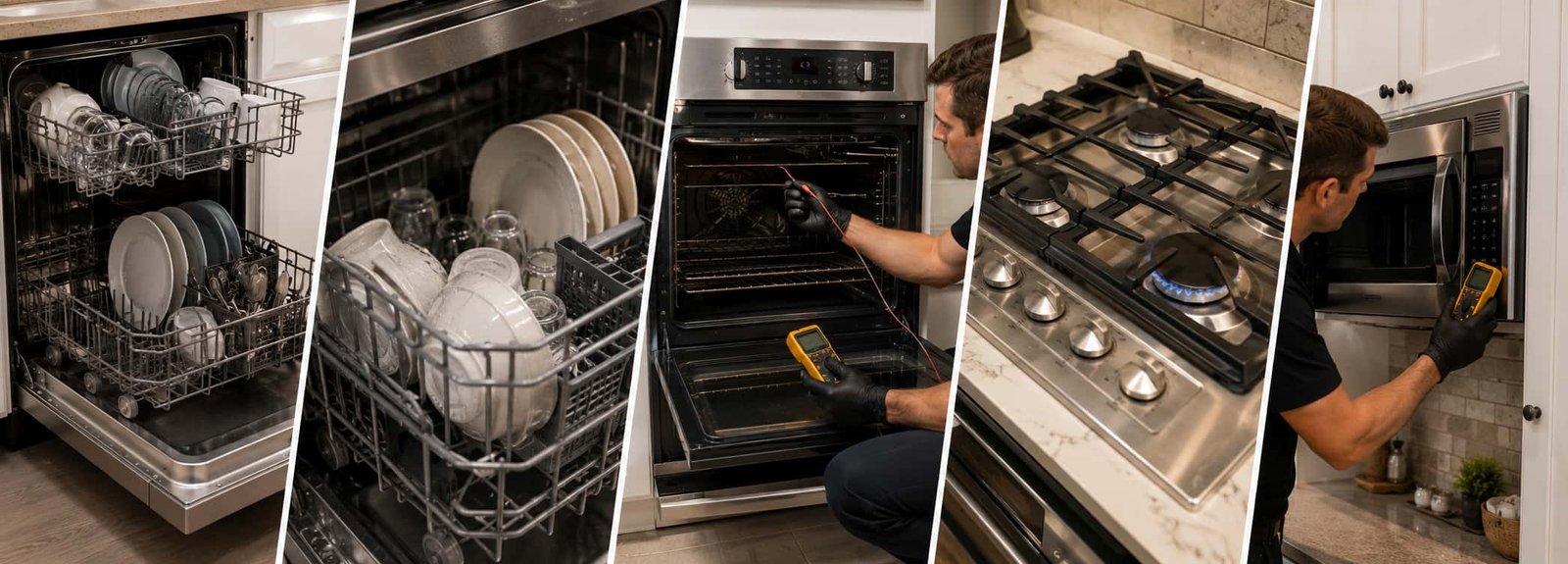
What the homeowner notices: Water remains below the filter, the dishwasher smells, water reaches the floor, the cycle pauses, or the control shows a drain or leak-related fault. Why it happens: Food and glass can block a filter or pump. The drain hose can kink, the sink connection or garbage disposal inlet can be blocked, a pump can fail, a float or leak sensor can activate, a valve or hose can leak, or the control can stop the cycle. What I usually find: The dishwasher and sink plumbing share part of the drain path, so I check both. After a new garbage disposal installation, the dishwasher may not drain because the disposal inlet knockout was never removed. On another call, the drain pump was blamed, but a small shard of glass had locked the impeller. Safe things to check: Turn off power, clean the removable filter, inspect the sink and disposal, make sure the drain hose is not visibly kinked, and look for water around the door. Do not pour aggressive drain chemicals into the dishwasher.Safe to check yourself
- Removable filter and visible food debris
- Sink or garbage disposal drainage
- Visible hose kink under the sink
- Door gasket debris and correct loading
Requires professional diagnosis
- Drain or circulation pump testing
- Hidden hose, sump, valve, or tub leak
- Leak sensor, float, wiring, or control fault
- Electrical damage from water intrusion
If water returns after the filter is cleaned, see our detailed guide to a dishwasher that will not drain or schedule dishwasher repair.
8Dishwasher Not Cleaning, Not Drying, or Leaving White Film
What the homeowner notices: Food remains on dishes, detergent stays in the cup, glasses look cloudy, plastics stay wet, or the dishwasher finishes without producing the result it used to. Why it happens: Loading can block spray arms or the detergent door. A dirty filter, low fill, weak circulation pump, blocked spray arm, cool incoming water, wrong cycle, missing rinse aid, failed heater, vent, fan, sensor, or control may reduce performance. White film can be detergent residue or mineral deposits. Permanent etching looks similar but cannot be washed away. What I usually find: Drying systems differ by brand and model. Many Bosch models rely on condensation drying and benefit from rinse aid and proper loading, so a wet plastic container does not automatically mean the heater failed. KitchenAid and other models may use a heating element, fan-assisted drying, or selectable dry options. I first confirm how the machine was designed to dry. Safe things to check: Clean the filter with a soft brush, confirm spray arms rotate freely, load without blocking the detergent door, run hot water at the sink before starting, use rinse aid if the manual recommends it, and choose the correct dry option.Safe to check yourself
- Filter, spray arms, and loading pattern
- Detergent freshness and rinse aid
- Cycle and drying option
- Visible scale or residue
Requires professional diagnosis
- Water fill level and circulation pressure
- Heater, fan, vent, sensor, and wiring
- Circulation pump or diverter failure
- Control not completing wash or dry stages
If cleaning performance changed suddenly and the filter, loading, and water supply are correct, the wash or heating system needs testing. Repeating heavy cycles may hide the problem while using more time and energy.
9Oven Not Heating, Preheating Slowly, or Cooking Unevenly
What the homeowner notices: The oven turns on but never reaches the set temperature, food burns on one side, preheat takes much longer, the temperature swings, or a gas oven glows without lighting properly. Why it happens: Electric ovens may have a failed bake or broil element, burned connection, voltage problem, sensor, relay, or control fault. Gas ovens often depend on an igniter that must draw enough current to open the safety valve. A weak igniter may glow and still fail to light reliably. Airflow blocked by foil or incorrect rack placement can also affect results. What I usually find: I measure temperature behavior instead of judging one preheat beep. Some ovens signal before the entire cavity stabilizes. I also compare bake and broil performance. If broil works but bake does not, that narrows the circuit. If both are weak, the power supply or control path becomes more important. Safe things to check: Confirm Bake mode, remove foil that covers a full rack or oven floor, inspect a visible electric element for breaks with power off, and verify the gas shutoff has not been moved. Use a basic oven thermometer only for a multi-cycle average, not one instant reading.Safe to check yourself
- Cooking mode, rack position, and foil placement
- Visible electric element damage with power off
- Household breaker and clock settings
- Door fully closing against the gasket
Requires professional diagnosis
- Gas igniter and safety-valve current
- High-voltage element and relay testing
- Sensor, calibration, wiring, and control diagnosis
- Burned connector or overheating repair
Our oven temperature troubleshooting guide covers the warning signs in more detail. For on-site testing, use our oven and stove repair service.
10Gas Stove Keeps Clicking, Burner Will Not Light, or Cooktop Heat Is Inconsistent
What the homeowner notices: A gas burner clicks after ignition, one burner will not spark, an electric element stays cold, an induction zone does not detect the pan, or heat changes without the knob moving. Why it happens: Moisture, grease, a misaligned burner cap, dirty ignition path, cracked igniter, switch harness, spark module, failed surface element, receptacle, infinite switch, sensor, inverter module, or control can affect a range or cooktop. What I usually find: Continuous clicking after cleaning often comes from moisture around the switch or igniter. That may dry, but a switch that keeps sending power after everything is dry needs attention. On electric coil units, a burned receptacle can damage both the terminal and the element. Replacing only the visible element may leave the overheated connection in place. Safe things to check: Turn power off, allow cleaned burners to dry, seat burner caps correctly, remove loose food with a soft brush, and confirm induction cookware is magnetic and centered. Never enlarge gas ports with a drill bit or pin.Safe to check yourself
- Dry and correctly seated burner parts
- Correct pan type for induction
- Visible removable element seating
- Breaker and control-lock settings
Requires professional diagnosis
- Spark switch, module, igniter, and gas valve
- Burned receptacle, switch, or wiring
- Induction sensor or inverter module
- Glass-top disassembly and control repair
If clicking continues after the burner is dry and correctly assembled, disconnect power and have the ignition circuit checked. Do not ignore gas odor or a burner that lights with a delayed “whoosh.”
11Microwave Runs but Does Not Heat, Sparks, or Has Door and Fan Problems
What the homeowner notices: The light, fan, and turntable run but food stays cold, the unit sparks, the door must be lifted to start, the over-the-range fan stops, or the display is dead. Why it happens: A no-heat complaint can involve settings, door interlocks, high-voltage components, the magnetron, inverter, transformer, diode, wiring, or control. Sparking may come from metal, damaged waveguide material, burned food residue, a damaged rack support, or internal arcing. Door alignment and switches are safety-critical. What I usually find: I first confirm the microwave is not in timer or demo mode and that the door latches correctly. After that, the cover stays on until the unit is made safe. Microwaves can store dangerous voltage even when unplugged. This is not the appliance to learn electrical repair on. Safe things to check: Remove metal, clean food residue after power is disconnected, confirm the door closes normally, check the breaker, and test with a cup of water only if there was no sparking, burning smell, or door damage.Safe to check yourself
- Timer, demo mode, and control lock
- Metal objects and removable rack position
- Door closing without lifting or slamming
- Household breaker and outlet power
Requires professional diagnosis
- Door interlock and latch adjustment
- Magnetron, inverter, capacitor, diode, or transformer
- Internal arcing or waveguide damage
- Control, fan motor, wiring, or thermal cutoff
Do not remove the microwave cover. For some countertop models, replacement may cost less than internal high-voltage repair. Built-in and over-the-range units deserve a repair estimate because installation and trim can change the math.
12Freezers, Wine Coolers, Range Hoods, Garbage Disposals, and Combination Units
These appliances create fewer calls than refrigerators and laundry machines, but the same problems repeat.Standalone freezers
A freezer that runs constantly may have a warm room, gasket leak, dirty condenser area, frost restriction, weak fan, sensor problem, or sealed-system issue. Chest freezers and upright freezers behave differently. Check the actual temperature with a thermometer before turning the control colder.Wine coolers and beverage centers
These units may use compressor or thermoelectric cooling. Poor ventilation, a failed fan, sensor, control, door seal, compressor, or sealed system can cause temperature drift. Built-in models need clear front ventilation. Pushing a freestanding unit into a tight cabinet can create a cooling problem that looks like a failed component.Range hoods
Weak suction may come from a saturated filter, blocked duct, incorrect damper, blower problem, or control fault. A hood that vents back into the kitchen cannot solve a blocked exterior duct. Clean filters are a safe first step. Motor, wiring, lighting, and internal control work should be tested with power off.Garbage disposals
A silent disposal may need the wall switch, breaker, GFCI, or reset checked. A humming disposal may be jammed. Turn power off before using the manufacturer-supplied wrench. Never place a hand inside. If it leaks from the body, has burned wiring, or repeatedly trips the reset, repair or replacement is usually safer than repeated resets.Stacked laundry and washer-dryer combos
Access changes everything. A stacked dryer may need the washer protected or the stack separated. All-in-one units share drainage, airflow, heating, and control systems in a compact cabinet. A long dry time may begin with a drain problem because the machine cannot remove enough water before the dry stage.Built-in and panel-ready appliances
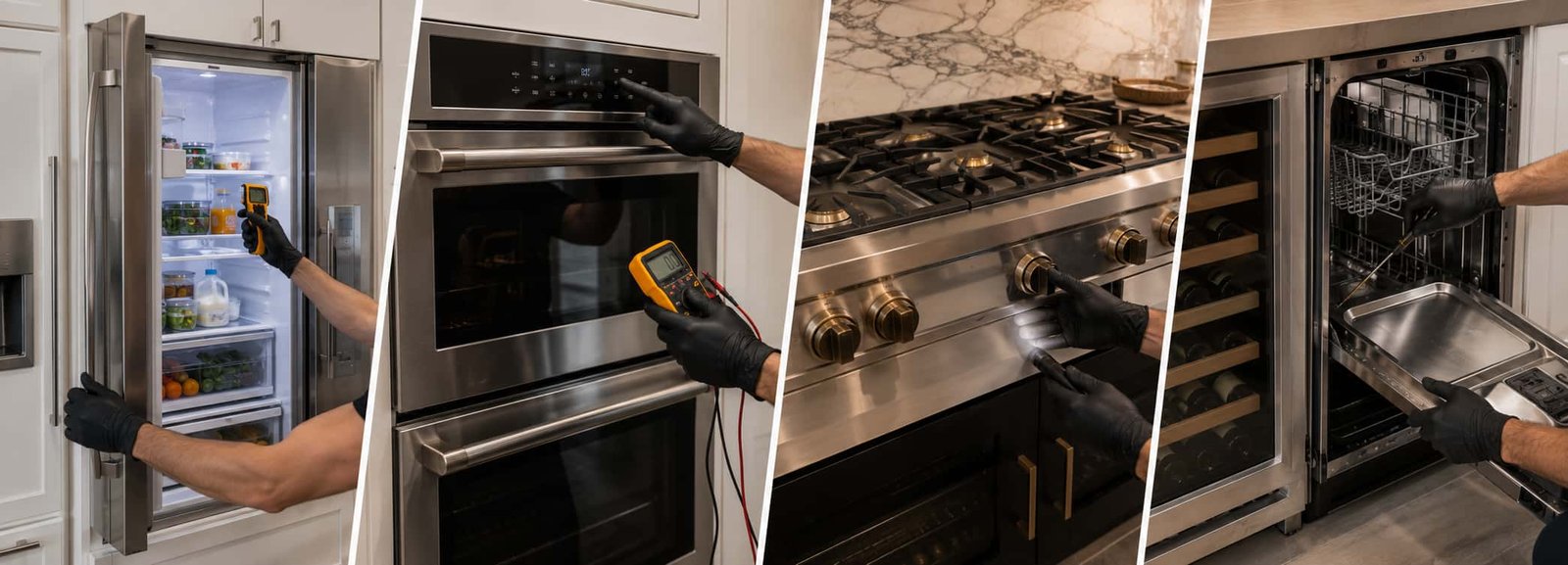
Custom panels, flooring, cabinetry, water lines, anti-tip hardware, and tight clearances can add risk. I plan the access before removing a built-in refrigerator, wall oven, dishwasher, or microwave. The goal is to repair the appliance without creating a cabinet or flooring repair.Typical Appliance Repair Cost in Pasco County
These are broad planning ranges for common residential repairs in the Tampa Bay market, not a quote. The exact total depends on the model, part price, access, damage, and whether the repair involves gas, high voltage, a sealed refrigeration system, custom panels, or premium built-in equipment. Appliance Repair Optimal’s standard diagnostic fee is $69 and is waived when the approved repair is completed.| Repair category | Typical planning range | Usually worth repairing? | Same-day possible? |
|---|---|---|---|
| Refrigerator fan, valve, ice maker, or defrost component | $220 to $550 | Often, if cabinet and sealed system are healthy | Often, with the correct part available |
| Refrigerator compressor or sealed-system repair | $700 to $1,500+, built-ins can be higher | Depends heavily on age, model, and replacement value | Diagnosis may be same day, completion may require parts |
| Washer pump, lock, valve, belt, or suspension repair | $180 to $450 | Often | Frequently |
| Washer bearing, tub, motor, or major control repair | $350 to $850+ | Compare age and total repair cost | Diagnosis yes, major parts may require return visit |
| Dryer heater, igniter, fuse, belt, rollers, or pulley | $180 to $400 | Usually | Frequently |
| Dishwasher drain, fill, latch, heater, or pump repair | $180 to $500 | Often, if no cabinet or floor damage exists | Frequently for common parts |
| Oven, range, or cooktop element, igniter, sensor, or switch | $180 to $500 | Often | Often |
| Control board, induction module, glass top, or premium built-in part | $350 to $1,000+ | Depends on appliance value and part availability | Usually requires model-specific ordering |
| Microwave, disposal, or range hood repair | $150 to $450 | Built-in units often make more sense to repair than basic countertop units | Sometimes |
Should You Repair or Replace the Appliance?
I do not use one age rule for every appliance. A ten-year-old standard dishwasher and a ten-year-old built-in refrigerator do not have the same replacement cost, installation work, or expected value after repair.Repair usually makes sense when:
- The appliance is otherwise clean, stable, and in good condition.
- The repair is a pump, fan, valve, igniter, element, sensor, belt, roller, gasket, or similar replaceable component.
- The model fits the space and replacing it would require cabinetry, plumbing, electrical, trim, or stacking work.
- The replacement appliance with comparable features costs much more than the repair.
- Parts are available and the diagnosis does not show multiple major systems failing.
Replacement deserves serious consideration when:
- The cabinet, tub, drum, liner, glass, or structural frame is damaged.
- A major sealed-system or control repair approaches the value of a basic replacement.
- Several unrelated major components are failing.
- Critical parts are discontinued or available only as questionable used components.
- The appliance has a history of repeated leaks, overheating, electrical damage, or unsafe operation.
Appliance Repair Across Pasco County
On the west side of the county, our routes commonly include New Port Richey , Port Richey, Hudson, Holiday, Trinity, Elfers, Seven Springs, Bayonet Point, and nearby communities. Refrigerator leaks, ice maker failures, washer drain problems, and dryer airflow complaints are common reasons homeowners call, but the diagnosis still depends on the appliance, model, and installation. In central and east Pasco, we serve Land O’ Lakes , Wesley Chapel , Odessa, Lutz, Zephyrhills, Dade City, San Antonio, St. Leo, Shady Hills, and surrounding areas when route availability allows. Newer homes may have stacked laundry, smart appliances, tight utility closets, and panel-ready kitchen equipment that require different access planning.Same-day appointments are available when the route, appliance, and schedule allow. Common repairs may be completed during the first visit when the correct part is available. Some premium, built-in, control-board, glass-top, and sealed-system repairs require a model-specific part and a return appointment.
Common Appliance Repair Questions from Pasco County Homeowners
What appliance problems do technicians see most often in Pasco County?
Why is my refrigerator warm when the freezer is still cold?
Can Florida humidity cause refrigerator frost?
Why will my washer not drain?
Why does my washer bang only during the spin cycle?
Why does my dryer run but not heat?
Is it safe to keep using a dryer that takes two cycles?
Why is water left in the bottom of my dishwasher?
Why does my dishwasher leave white film on glasses?
Why does my gas stove keep clicking after the flame is on?
Can resetting an appliance fix the problem?
How much does appliance repair cost in Pasco County?
Is an older appliance worth repairing?
Do you offer same-day appliance repair in Pasco County?
What warranty comes with a completed repair?
Technical References Checked
Field observations in this guide were cross-checked against current manufacturer troubleshooting and official local information. Model-specific manuals and service sheets always take priority.- Pasco County Utilities water quality reports
- Samsung refrigerator ice maker troubleshooting
- LG refrigerator weak-cooling guidance
- Whirlpool washer not draining or spinning guide
- Maytag washer vibration and shaking guidance
- Whirlpool dryer not heating guidance
- Bosch dishwasher drying guidance
- KitchenAid dishwasher troubleshooting guide
- GE Appliances oven heating troubleshooting
- GE Appliances microwave runs but does not heat
- InSinkErator garbage disposal support
- FoodSafety.gov refrigerator and power outage guidance
Still Not Sure Which Part of the Appliance Failed?
If you have checked the power, settings, filters, visible hoses, door closure, and simple blockages but the symptom has not changed, it is probably time to have the appliance diagnosed properly. Appliance Repair Optimal services refrigerators, freezers, ice makers, wine coolers, washers, dryers, stacked laundry, washer-dryer combos, dishwashers, ovens, ranges, stoves, cooktops, microwaves, range hoods, garbage disposals, and other major household appliances across Pasco County. Same-day service is available when the route and schedule allow. Eligible completed repairs include a 90-day warranty on installed parts and a 30-day warranty on labor.